

Pokémon Resin Artisan Keycaps: Make Your Keyboard Uniquely Yours
A mechanical keyboard can be practical, carefully tuned, and still feel strangely anonymous. Matching switches, a coordinated cable, and a clean set of keycaps create a polished desk, but they do not always say much about the person using it. One small accent can change that. A handmade Pokémon resin artisan keycap turns an ordinary key into a miniature scene—part keyboard component, part collectible, and part personal signature.
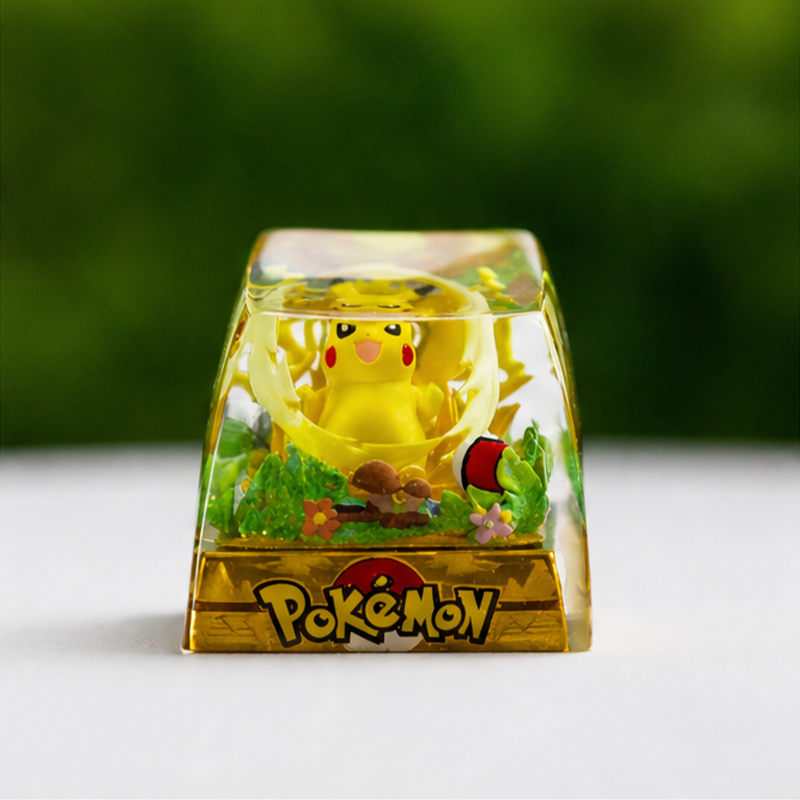
That distinction matters when choosing a gift. A full PBT keycap set is useful and visually consistent, but it is also designed to be repeated across thousands of keyboards. A resin artisan keycap takes the opposite approach. Its purpose is not to replace every key. It is to give one carefully chosen position enough character to become the detail people notice first.
For Pokémon fans, that focal point can reflect a favorite character, an early gaming memory, or simply the colors that complete a desk setup. The result does not need to be loud. One tiny scene on Escape, a function key, or a macro key can make the entire board feel more personal.
What Makes a Resin Artisan Keycap Different?
Most standard keycaps are molded to prioritize consistency. Artisan resin keycaps are made to create depth. Instead of placing a flat graphic on the surface, a maker builds a small composition in layers, casts it in resin, and finishes the exterior so the scene can be viewed through the cap.
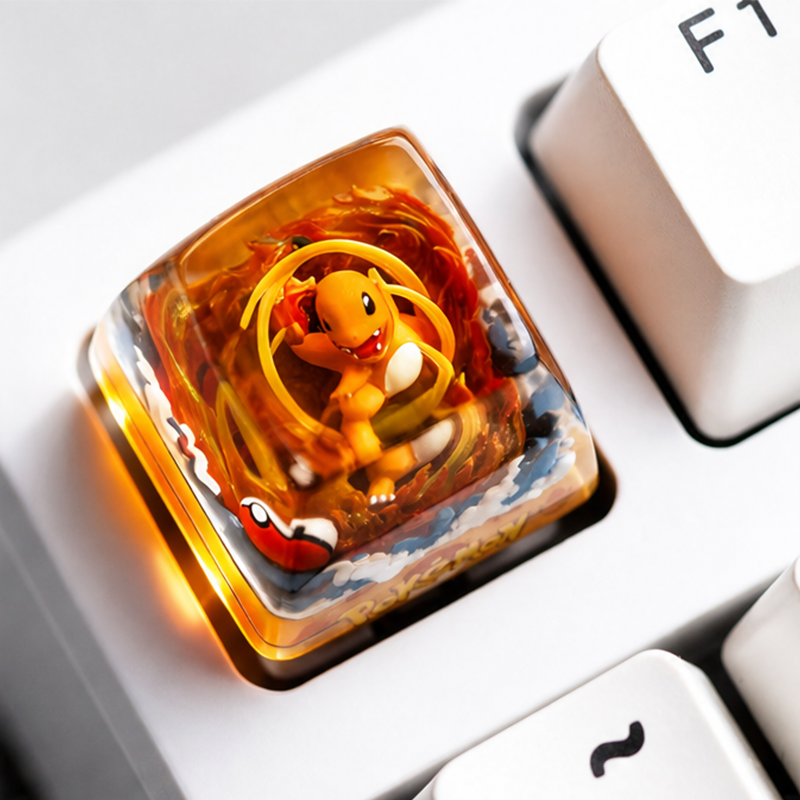
The Pokémon Miniature Scene Resin Artisan Keycaps use layered epoxy resin and are described as hand-cast and hand-polished. The collection includes character-inspired options such as Pikachu, Charmander, Mew, Bulbasaur, Gengar, Squirtle, Snorlax, Eevee, Umbreon, and others. Each cap occupies one standard key position, sits at approximately SA height, and fits cross-shaped MX-style switch stems.
The handmade process is the real point of difference. Casting a clear object around a miniature scene requires care at several stages: placing the visual elements, controlling the resin layers, preserving clarity, and polishing the finished surface. Small variations are natural in handcrafted work. Rather than making the piece defective, subtle variation is part of what separates an artisan object from a mass-produced print.
This is also why resin artisan keycaps are best understood as keyboard jewelry. They remain functional, but their visual and collectible qualities are just as important as the keystroke itself.
PBT Dye-Sublimated Keycaps vs. Resin Artisan Keycaps
PBT dye-sublimated keycaps and resin artisan keycaps are not direct substitutes. They solve different problems, and the strongest setup often uses both.
Why People Choose Dye-Sublimated PBT
PBT is popular for everyday keycap sets because it feels slightly textured, resists the shiny wear that can develop on some plastics, and works well for a board that sees hours of daily typing. In dye sublimation, heat transfers dye into the keycap surface rather than leaving a raised layer of ink on top. The legends are therefore durable and do not simply rub away with normal use.
A PBT set also delivers consistency. Every row follows a planned profile, the legends align, and the colors repeat across the entire keyboard. For users who want one cohesive theme, predictable typing feel, and good value across 60 to more than 100 keys, PBT is the practical foundation.
Its limitation is dimensional. Even a beautifully illustrated dye-sublimated design is still primarily a surface graphic. It can tell a visual story, but it cannot create the suspended depth, shifting reflections, or tiny diorama effect of layered resin. Because PBT sets are produced in batches, another fan can easily own the exact same arrangement.
Why People Choose Handmade Resin
Resin gives a maker room to work in three dimensions. A character can sit inside a miniature environment instead of appearing as a flat legend. As the viewing angle changes, foreground and background elements separate, and the key becomes a tiny display object.
That visual depth is difficult to imitate with printing. Hand casting and polishing also give the piece a human story: someone assembled, poured, cured, inspected, and finished the individual cap. For a collector, that process adds meaning beyond the image itself.
There are tradeoffs. Artisan caps cost more per key, may sit taller than the surrounding set, and deserve gentler handling than a standard PBT cap. Their sculptural shape can also make them less suitable for heavily used letter keys. None of those points is a flaw; they simply explain why artisans work best as accents rather than full-board replacements.
| Feature | Dye-Sublimated PBT | Handmade Layered Resin |
|---|---|---|
| Main strength | Consistent daily-use keycap set | Distinctive collectible accent |
| Visual effect | Durable two-dimensional print | Three-dimensional miniature depth |
| Feel | Uniform and practical for frequent typing | Taller, more sculptural focal key |
| Uniqueness | Batch-produced and repeatable | Hand-finished with natural variation |
| Best placement | Letters, numbers, and most of the board | Escape, function, macro, or display key |
| Care | Routine keycap cleaning | Gentle cleaning; avoid abrasives and harsh chemicals |
The simplest answer, then, is not “PBT or resin?” Use PBT for the keyboard’s dependable base and one resin artisan for the moment of personality.
How to Build a Pokémon Keyboard Without Overdoing It
A themed setup feels more considered when every item does not compete for attention. Start with the artisan cap and let its colors guide the rest of the board.
For a Pikachu-inspired scene, a neutral cream, charcoal, or white PBT set gives the yellow accent space to stand out. A Gengar design can work with black, deep purple, or gray caps and a restrained violet backlight. Bulbasaur and Squirtle pair naturally with cooler greens and blues, while Charmander can add a warm orange focal point to a dark setup.
Placement is just as important as color. Escape is the classic artisan position because it is easy to see and used less often than letters or the spacebar. On a larger board, consider a function key above the number row. On a custom layout, a macro key can turn the artisan into a purposeful control—for example, the key that opens a favorite game or launches a music playlist.
Before installing any artisan cap, check three things:
- Stem compatibility. These caps are intended for cross-shaped MX-style stems. Check the Keycap Compatibility Guide if the recipient’s keyboard uses a less common switch or low-profile design.
- Clearance. Approximately SA height means the artisan may stand above Cherry-, OEM-, or XDA-profile neighbors. That contrast often looks intentional on Escape, but it may feel distracting in the middle of a typing row.
- Lighting. Side lighting can reveal the resin layers more effectively than maximum RGB brightness. Try a soft static color before choosing a complex animation.
The goal is not to turn the keyboard into a billboard. It is to make one meaningful object feel as though it belongs there.
Why It Works as a Gift
Buying for a mechanical-keyboard enthusiast can be intimidating. Switch weight, layout, sound preference, and keycap profile are personal choices. A complete set asks the buyer to guess all of them. A single artisan cap is a more focused gesture.
The character selection makes that gesture specific. Choosing a favorite Pokémon shows that the gift was not selected from a generic “gifts for gamers” list. At the same time, the miniature scale keeps it useful for someone who already has a carefully arranged desk. It adds a story without requiring them to rebuild their keyboard.
It also bridges two collecting habits. Pokémon fans understand the appeal of choosing a favorite character, while keyboard enthusiasts appreciate materials, finish, and small-batch craftsmanship. A layered resin keycap sits neatly between those worlds.
If you are unsure which character to choose, look for clues in the recipient’s existing setup: desk-mat colors, avatars, game profiles, figures, stickers, or the Pokémon they use most often. The best choice is not necessarily the most recognizable character. It is the one that makes the recipient say, “You remembered.”
Caring for a Hand-Polished Resin Keycap
A little care keeps a clear resin surface looking its best. Remove the cap with a keycap puller rather than twisting it by hand. Dust it with a clean, soft cloth, and use a slightly damp cloth for fingerprints. Avoid abrasive pads, strong solvents, and very hot water. When the cap is not installed, store it away from sharp objects and prolonged direct sunlight.
For broader maintenance advice, see the Product Care Guide. Treating an artisan as a miniature collectible—not just another piece of plastic—is the right mindset.
A Small Key Can Change the Whole Setup
Personalizing a keyboard does not require replacing everything. A reliable PBT set can handle the everyday work while one handmade resin keycap carries the story. That balance is what makes an artisan accent compelling: it is small enough to integrate into an existing setup, but detailed enough to make the board feel unmistakably personal.
For the Pokémon fan who already owns the games, figures, or cards they want, a miniature scene in an unexpected place can be a thoughtful next gift. It turns a tool they touch every day into a tiny display for a character they love—and gives an otherwise polished keyboard something no spec sheet can provide: identity.
FAQ
Are Pokémon resin artisan keycaps compatible with every mechanical keyboard?
No. This collection is designed for cross-shaped MX-style switch stems. Low-profile switches, proprietary stems, membrane keyboards, and some non-MX designs may not be compatible. Check the keyboard switch and layout before ordering.
Can I replace an entire PBT keycap set with resin artisan caps?
Technically, a compatible resin cap can replace a standard single key, but artisan caps are generally best used as focal accents. PBT is more practical and consistent for the main typing area, while resin adds visual depth to one or a few selected positions.
Where should I place an artisan keycap?
Escape is the most popular position because it is visible and not used continuously. Function keys and macro keys are also good choices. Avoid placing a tall artisan where it could interfere with rapid typing.
Are these keycaps handmade?
The product is described as hand-cast and hand-polished. Because hand finishing is involved, minor variations between pieces can occur and are part of the artisan character.
How should I clean a resin artisan keycap?
Remove it with a keycap puller, then wipe it gently with a soft dry or slightly damp cloth. Avoid abrasive cleaners, harsh chemicals, very hot water, and prolonged direct sunlight.
Is a resin artisan keycap a good gift if I do not know the recipient’s keyboard layout?
It can be, provided you confirm that the keyboard uses an MX-style cross stem and has a standard single-key position. Character preference is usually more important than layout once compatibility is confirmed.